Blog

The Third Surprising Reason Why Meditaion Works

There are three basic components to meditation that makes it so magically reviving. First – body relaxation – obviously tensed muscles create stress so the opposite is good, complete short term drop of tension. 

Second – the mind is taken off its usual worry circuit and into an empty plain, which again gives the body a chance to relax and recoup instead of constantly reacting to our thought process.  This state of calm means that the body could begin to self-heal.

The third one might come as a surprise to some people. During the proper meditation the breathing activity slows down. There are longer intervals between each exhale and inhale (the pause before the next inhalation). And the breathing becomes shallower like in a deep sleep. 

This third effect I would like to look at more closely today. As it’s also the cause of profound healing that is happening to the body during and as the result of meditation.  Yogis for the longest time were practicing pranayama – the art or technique of controlling and slowing one’s breathing ascribing wonderful properties to such practices. The extreme example was of some ascetically accomplished persons to stay underwater for about 30 days without breathing. 

Yet we all know that oxygen is absolute must for our body cells to support life. So we are always advised to inhale deeper and keep it longer inside before exhaling. It took a scientist totally unfamiliar with yoga to prove the deep breathing wrong.  Konstantin Buteyko, Soviet professor of medicine, claimed that deep breathing only increases the amount of unusable oxygen in the blood stream which doesn’t guarantee but hinders its reception by the body cells.  He is said to help Prince Charles to overcome his horse hair allergy, who referred to controlled breathing as a real help to allergy and asthma sufferers in his passionate essay for The Guardian in 2004. 

The controlled breathing method is based on the fact that proper absorption of the oxygen is dependent on the level of CO2 (carbon dioxide) in the blood. At maximum it must be equal to 6.7 % in the blood stream. Routinely people have up to 3,7 %. By slowing down the breathing process and making it shallower the body’s ability to retain CO2 increases which then supports the ability of the cells to receive oxygen from the blood stream. 

By practicing slower and shallower breathing for couple of weeks you can increase the level of CO2 (which body produces naturally as the result of its function) by one to two points. At such a mark things like asthma and other respiratory illnesses including allergy immune disorders are claimed to improve to the point on nonexistence. 

The Buteyko method of controlled breathing recommends practicing relaxation with slower and shallower breathing 15 minutes three times a day. This brings us back to meditation. Its profound healing effect does have a scientific basis although not widely recognised. 

 © Dana Johnson

Relationship Skills for Women

I believe relationships are at the core of our being. From early days of mother-baby then father-child, siblings connection and eventually life partners – these are the corner stones that give shape and meaning to all what we do. I lived my adult life in running away mode until my thirties and then spent a decade reconnecting with my family and started to have ‘towards’ goals. I discovered my heart finally at the begining of my fourth decade. I’m so grateful for this awakening to happen and feel that I can give so much to others to  find or heal their hearts, too. There are two ways we learn in life from personal experience which often means suffering or through wisdom that exists in the body of knowledge others could show us. So I went through both. I spent the last few years studying Vedic psychology and learning from the masters in the field of life coaching.  I begun working with women on all kinds of relationship issues.

My new web page ‘Relationship Skills for Women’ contains my current individual and group coaching courses for women who would like to be or already are in a relationship as well as information about coaching on all family concerns. Check it out below what is there for you:

Relationship Magnet – You are single and looking for a great committed long-term relationship.

Image result for single women

Learn what you can influence and control in your life in order to find, attract and keep the right person and build a stable relationship. Explore what is in your current reality and mindset that precludes you from selecting, connecting and staying with the one for you. “Relationship Magnet” is an individual or group course for up to 8 weeks.  Book a group of 6 – 10 girlfriends and up to two will have it for free. Call 07917376004 for a free 15 minute consultation. Email to arrange Skype or other web supported connection.

Relationship Bliss – You are on top of the world and happy as happy can be, so why would you need a relationship coach? Learn the secret of how to stay blissfully together even after the initial infatuation is over and everyday reality sinks in.

There are four components to every relationship – mental, emotional, physical and spiritual. In the beginning it’s usually one or two that attract people to each other and if the other two or three are not aligned and present our happiness is often as fragile as a bubble in the air. Learn to master all four of them as well as skills of loving communication and confrontation, and enjoy life to the fullest. This course is available as individual or group coaching; give it as a gift to your hen party, flower girls, or girlfriends and get a discount. It’s a three-week course for a woman who wants to know exactly how to keep happiness and grow in it together with her partner. Inquire to schedule your own sessions or join a group. Call 07917376004 for a free 15 minute consultation. Email to arrange Skype or other web supported connection.

Relationship Check-up or ‘MOT’ – You’ve been and weathered together a little or a lot and are now at a stage of an open plain, m.b. even a plateau, or is that a fork on the road ahead; or your family situation is changing with new children on board, children growing or emptying the nest. Whatever the reason, something is changing or standing still without a breeze for some time.

Before boredom and casualness sets in there is a spark that could be reignited, brought back or a new flame found, fresh air let in. As a woman you hold the reins of the relationship.  It’s up to you to wish it to a completely new level. This four-week individual or group course will examine your possibilities of growing and expanding your relationship and establishing even deeper and satisfying connection. Book your group and one comes free. Call 07917376004 for a free 15 minute consultation. Email to arrange Skype or other web supported connection.

Relationship ‘SOS’ – Wait, it’s not the time to panic. It is time to take control and see clearly what works and what doesn’t and why.

Image result for unhappy couple imagesThen it’s time to learn what could be done to change what is not working. It’s time to take action and know precisely what steps to take to turn things around. It is almost never too late. It’s a question of one’s dedication, effort and belief. Come to the individual or group sessions for 6 weeks initially and reverse the situation no matter how hopeless it seems at present. Call 07917376004 for a free 15 minute consultation. Email to arrange Skype or other web supported connection.

Relationship In the Family – Are your close relations causing you pain, are you struggling to find love and understanding  with your parents, siblings or children?

Take action to bring peace and comfort in every relationship that is misunderstood or hurting and taking away from your current happiness and confidence. These vital life connections affect all other spheres of our lives, they are the blood that fills the vessels of our success and social standing and building stones of happy intimate relationship. When these primary ties are at fault, quite often our life power is drained and purpose is missing. Bring back the love or establish the connection anew with your mum, dad, brother, sister or child and your wings will soar again. This is a an 8  to 12 week individual or group course. Call 07917376004 for a free 15 minute consultation. Email myinnerpowercoach@gmail.com to arrange Skype or other web supported connection.

© Dana Johnson 2015

‘The Theory of Awesomness’ the State of Flow

‘You must have goals but your happiness cannot be tied to these goals. You must be happy before you attain your goals.’

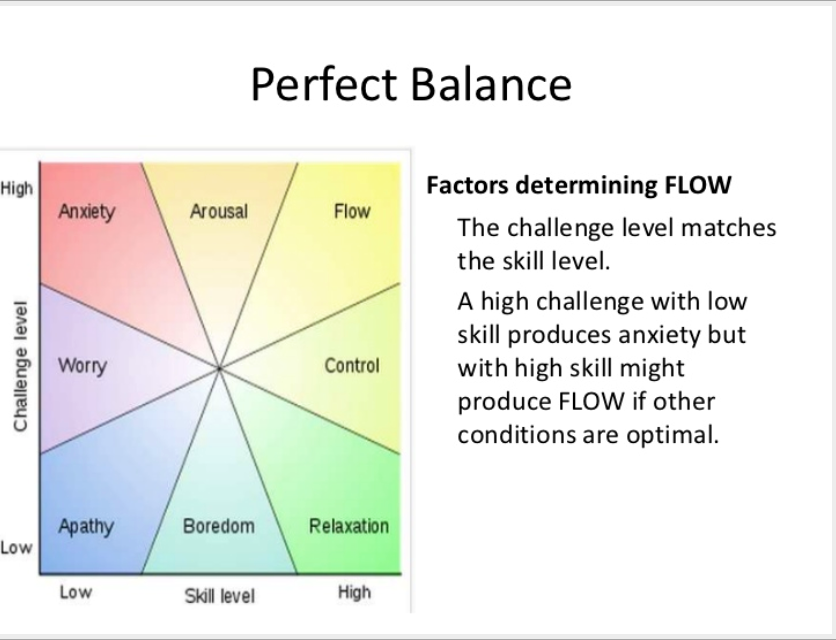
To me this poster represents the whole paradigm of personal development. While as a coach I help you to set and achieve your goals and dreams and align them to your core values and examine limiting beliefs our first step will be finding your happiness and certainty in the present as this is the key or formula for success – (1) being happy in the present moment, (2) having a future vision and (3) acting upon it. Acting comes naturally when you have first two in place. When you don’t have present happiness only a huge future vision you are set for stress, anxiety and eventually burnout; when you have none of the ingredients it’s a negative spiral down to depression and apathy; present happiness without future vision often ends up in boredom and stagnation called ‘current reality trap’ in the poster.

The Theory of Awesomeness InfographicAs a Mindvalley ‘forever student’ I continuously learn from the advanced coaches, mentors and teachers in the field as they say that the fairy dust or brain power rubs off and being in the company of happy and forward looking people elevates others around them. If you are trying to change your life and make a positive difference it’s only natural to hang out with people who are positive, happy and successfull.

 Finding Flow And Playing Big

This is the topic of our upcoming workshop at Chiltern Escapes retreat for women this Friday and Saturday 24th and 25th April. 

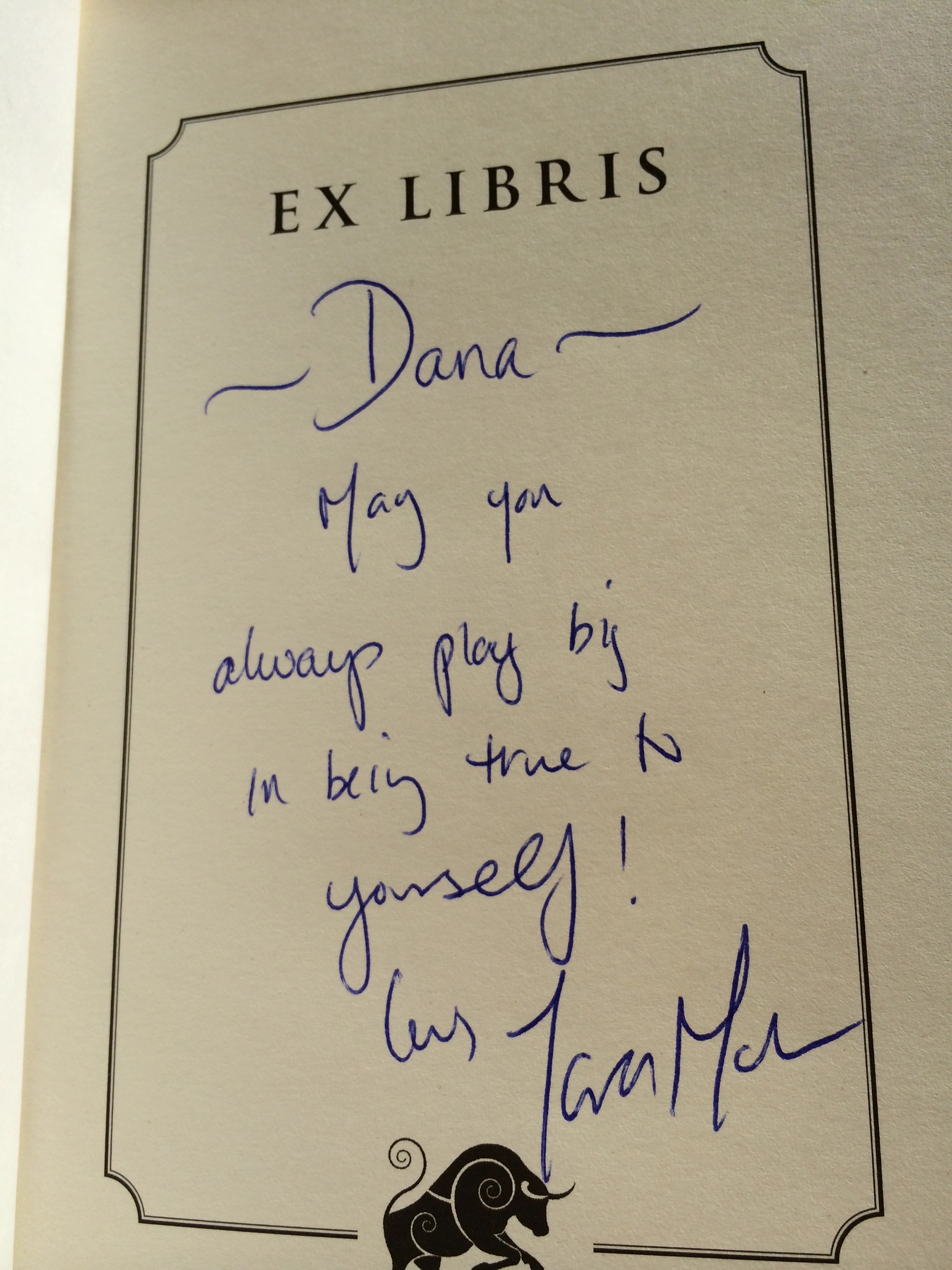
We will introduce and discuss these two great practical concepts: the first one is from a great psychologist Mihaly Csikszentmihalyi who has been studying happiness for forty years of his professional life; the second – from women’s coach and author Tara Mohr.  Their respective books Flow and Playing Big brought a very fresh and energising perspective into the world of personal growths and fulfilment. 


At these Chiltern Escapes dates the plan is to get into the nitty gritty of the practical application of these powerful ideas, recognise our own states of flow and opportunities of playing big in personal life, relationship and work. I am very excited and looking forward to it! 


What Other People Think

At the time I saw this poster on Facebook I commented, ‘It’s not a problem.’ Now, when preparing to my next workshop at our next Chiltern Escapes day on 24 April, I’d like to add a bit more, ‘The problem is not what other people think of us, the problem is what we think other people think of us because mostly they don’t even think of us!’

It is our inner critic filling in the gaps of missing information and we believe it. At our our workshop we will examine our inner critic and the ways to deal with it. It happens so that women’s inner critic is much stronger and more negative than that of men. And it causes serious grievance for many at their work place as women often underachieve and shy away from promotions and opportunities as well as are more sensetive to office politics.

It is so for many reasons. But one of the basic ones lays in the difference between feminine and masculine energies. Masculine energy minimizes and dismisses problems and criticism in order for its carrier to survive, move on and lead. Feminine energy magnifies and exaggerates problems, because it’s more sensitive to  other people’s feelings in order for everybody else (babies, young children, old and fragile people) to survive and thrive around the carriers of feminine energy. I have to add here that both adult men and women could be in each energy depending on situation and their own state, so when you read masculine it doesn’t mean all men only, the same is true about feminine and women, that’s why I used ‘carrier of the energy’ instead. Knowing this we all can adopt flexibility at work and home in order to lead more productive, happier and fulfilled lives.

Back to dealing with our inner critic. While we cannot get rid of it completely we can harness it. There are a lot of exercises for our Friday group of women to see the ways their inner critic is not helping them at work or home, when that mostly negative and nagging voice is exposed many women experience great changes for themselves in work environment and intimate relationships. Also the process helps to distinguish inner critic from the voice of inner wisdom which speaks with warmth, compassion and positive perspective. I’m looking forward to our workshop on Friday.


Making a Decision?

I’d like to share a tool that would help you achieve clarity and disclose hidden worries and issues when making a decision just about anything, especially decisions that are ‘life changing’. Sometimes facing them can keep us on hold for a long time, as our brains don’t distinguish the stress produced by a real threat from a perceived one, and often use the stress model of ‘fight, flight or freeze’ mechanism to cope. Often we put our lives on hold while making those decisions as we cannot face all the aspects of what is stopping us from moving forward.

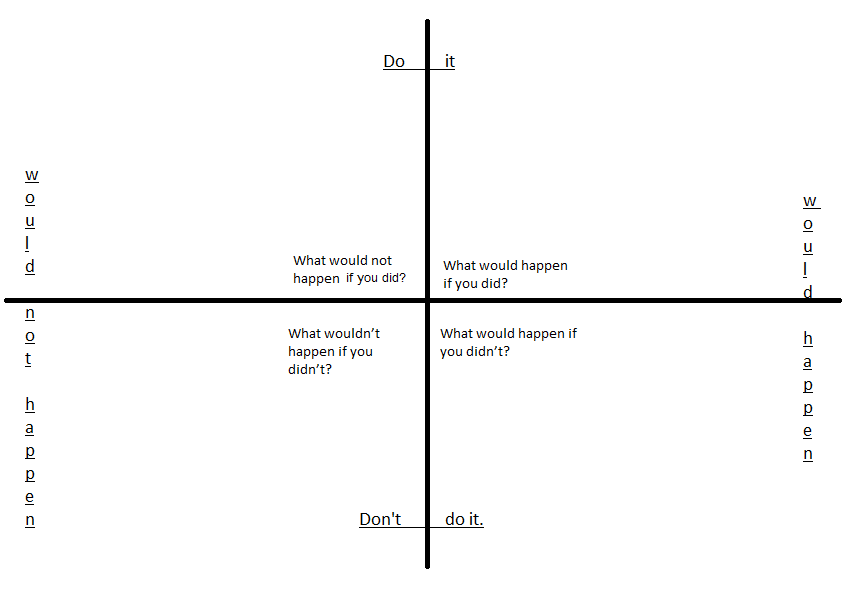
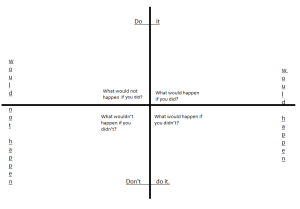
This tool has a fancy name Cartesian Questions based on Cartesian logic founded and used by the 17th century philosopher, mathematician  Rene Descartes. Present day Neuro-Linguistic Programming (NLP), sometimes used in coaching practices to a great effect, became very fond of it too.
Cartesian Questions

The beauty of the questions construed in this way is in its simplicity and yet it is capable of uncovering the depths of one’s unconscious mind and bring it all to the light of day. You can do it on your own or your can talk it through with someone.

So when you have a certain outcome in mind or need to make a decision about changing something or starting a new project, ask yourself:

‘What would happen If I did fully achieve the intended outcome?’

This asks you to see clearly the effects of your decision. How would this affect my situation, my relationship, health, work, leisure, possessions, achievements, my other desires and aspirations, new goals? Another huge thing to consider – do you expect that achieving a certain outcome will make you feel differently? Compare it to what you feel now and is it the change of your feelings you are after? As honestly as you can evaluate your feelings in your current situation and find all the pluses in it. Often changing your feelings first is a solution by itself. It’s not the easiest but certainly healthier way forward. Feelings are only a part of your current state that includes your thoughts and behaviour as well. All these have to be taken into account when evaluating the total outcome of your decision or goal setting. As there often enough is at least one if not a range of possibilities to find an easier and less costly way to achieve what you are after.

Here is a sample of questions to have a structure to work on:

  • How certain am I that I really want this?
  • What do I expect to have once I reach the goal?
  • What is it I am really after?
  • What changes will it bring to my situation?
  • How will I accommodate the changes in my current situation?
  • What does it mean and will mean to me to achieve this goal?
  • What is next?

‘What wouldn’t happen if I did achieve it?’

Posing this question will help you see the good things that you habitually overlook in your current situation because often enough you take them for granted. These ‘goodies’ might be lost to you when you get to your new goal/decision. For example, a career woman, let’s call her Anna, and her partner wanted to get out of London to be closer to nature and have a more relaxed life style and bigger space for themselves. It only became obvious to her after couple of years of commuting that her leisure time that she spent shopping on her own after work and walking in a nearby park was swallowed by the commute as well as almost three hours of sleep. Anna noticed it only after she got tired and exhausted which was exacerbated by a stressful work situation. The shopping time on her own – her little pleasure she never thought much of – turned out to be her major ‘me time’ which was a way to reconnect with self and be on her own however public the shopping environment might seem to others. It wasn’t a big deal to think about and admit it when they decided to move out of London, but became apparent in crisis that eventually brought her to me and other professionals. If she’d asked herself this quite simple question when moving she might have identified her little pleasure habit and it would give her a new perspective on the house-hunting location. Her daily ‘me time’ and several hours of sleep, foregone due to the extra commute, over years accumulated to the point that when she needed her power (adrenal strength) to carry her through stress, the resources weren’t there.

‘What would happen if I didn’t achieve my intended result, make this particular decision?’

Answering this honestly will show you the price of not changing and staying where you are. Often it is a painful experience in our present situation that motivates us to change. So if you continue, the pain continues. Or if there is no pain involved the exact cost of staying put will show up anyway and still be enough to move you forward. I like this simple saying: ‘This day next year you’d wish you started today.’ My best example is about my relationship with my mother, my dearly beloved mum for whom I felt I lived all my life. Yet, when I brought her to live with my family I couldn’t live in peace. My whole baggage of ‘childhood trauma’ drama of being emotionally disconnected from her came out and played often enough to make our lives miserable. It’s only when I faced the future cost of my behaviour that I could make a decision to change my attitude and behaviour.

‘What wouldn’t happen if I didn’t do, decide, achieve my goal?’

This question on the face of it doesn’t have any logical meaning, yet the semantics of it create a chaos in your rational mind and provokes you to think intuitively. It opens up the possibilities that were never there in your intended rational decision making and yet invites you to play with different eventualities of life that otherwise never come to mind. Basically it gives you the opportunity/permission to create the other reality without directly saying to you “don’t do what you want to do”. If you say to your brain don’t pursue your goal you have other things to do, it often creates a mental block against those other things, because the aspiration or the desire of the intended outcome is so strong that it won’t let you think anything else. In other words this brings you back to your conscious mind and senses to evaluate life  as it is (It’s lack, abundance and everything in between) without jeopardising the confidence and the strength of the intention to achieve what is desired.

This process of going through a decision making or goal evaluation is totally useless when you have a moral duty or obligation to fulfil. In such situation only the values and commitments matter and cost and possible side effects won’t make any difference to a conscientious human.

In all other situations have fun (as much as you possibly could) exploring the depths of the Cartesian logic in problem solving such as moving up or down a career ladder, expanding/downgrading your house, moving the country, or out to the country, changing profession or work/living place. These are not light-hearted decisions to say the least and if you need help to make them, yours truly is a phone call away.


Emotional Snakes and Ladders – overcoming the negativity bias

Thank you Elaine! Really helpful post – Emotional Snakes and Ladders – overcoming the negativity bias.

For many of us, emotions are things that happen us – sometimes a tornado that blows us off our feet or a sinking that silently drags us down. Or a feeling of elation as fleeting as the sun on a winter afternoon or a burst of joy – here and gone in an instant.
Recent research in neuroscience informs us that our brains are wired to be focussing on what is wrong with things. It is known as the « negativity bias ». Not only is the negativity bias an evolutionary trait of humans but we can see that it is also a trait of nations and maybe even the world. If we see nails everywhere, our only response will be a hammer, right ?
We know that putting on a happy face or ignoring suffering will not effectively allow you to « manage » your emotions, or « manage » your stress. Now we learn that the brain is being sculpted from each emotion, perception and experience and slowly but surely we accumulate a mind that is wired from our lived experiences.
Much as your body is built from the foods you eat, your mind is built from the experiences you have. Rick Hansen

Many of us we have a limited repertoire of emotions. Under duress, and depending on your personality and how you have wired your brain over the years, we tend to have a fairly predictable emotional response – anger or tears, action or withdrawal, etc. If moderate to chronic stress becomes a regular state of affairs in our body mind – and this is the modern condition – it makes us vulnerable. Stress releases cortisal into the brain that stimulates an alarm bell which sets off the amygdala which in turn kicks off the fight and flight response. It is all good except when chronic stress becomes a way of life. Cortisol actually kills neurons in the hypocampus and what should be passing mental states become lasting neural states and gradually change the very structure of the brain so we become even more sensitive to stress.
Stess impairs our immune and digestion functions, depletes our neural transmitters, and makes us vulnerable to such emotional states as depression and frustration and anger, which in turn can result in becoming driven and anxious, or on-going feelings of loneliness and disconnection.
This is important knowledge : the brain is all set up for processing those negative emotions of fear, anxiety, anger. In fact, our brains are built to be continually scouting for what is amiss, wrong or potentially problematic so that we can have a better chance of surviving an attack or a danger in the environment. Or the subjective perception of one.
Rick Hanson, neuroscientist and meditation teacher refers to this « negativity bias » as being in the brain’s « red zone » – the brain, he says, is like velcro for negative emotions (they tend to stick) and teflon for positive emotions (they tend to slide quickly away). Simply put, the brain is good at learning from bad experiences and bad at learning from good experiences.
It is clear that we all need to overcome our brains’ hardwired negativity bias – but how ? Let’s first have a look at what emotions we are talking about. This Emotional Scale is taken from Abraham Hicks work and shows the way one emotion feeds another as we go progressively either up or down the emotional spiral :
This scale reminds me of the child’s game Snakes and Ladders. As you can see, you can’t get from Depression to Joy in one step – like a ladder you have to climb up or slide down – It may be good to know that Anger is already higher up on the emotional ladder than Despair ! A victim mentality is very low on the scale – right down there with Powerlessness. If you can play the Appreciation Game (a Law of Attraction Coaching Process) you can climb steadily the ladder right up to the top alongside Love and Joy.
Today we have abundant scientific research that allows us to understand what is happening in our body and minds when we experience what is commonly called « negative » emotions. Sometimes, we aren’t even aware that we are on a downward emotional spiral because we are accuustomed to it and we have put in place some coping strategies – until we suffer from ongoing back pain, or sciatica or a chronic illness and we have to pay attention.
Mindfulness practices propose that we start by bringing into our awareness our emotional state, as it is showing up in our bodies and as it is expressed in our narratives (the things that we are telling ourselves). But it is all very well to recognize that one is truly pissed off or melancholy or depressed – to seek the cure from an external source in the form of prescription medication or alternative remedies (millepertuis for depression..) but the source of the emotion often remains hidden from your awareness and so continues to generate the anxiety or the anger in more subterranean ways. The body never lies !
Living in constant stress has become a way of life. In our modern world we are training our brains to constantly zap from one screen to another, from one information bite to another. This actually contributes to avoidance strategies. Whatever the psyche cannot integrate, the body will express. We could go so far as to say that whatever the physical symptom, there is always an emotional and mental component to it. If we believe that we have no choice but to continue in a job we hate or in a relationship that has become empty or hateful then our brains will make this a reality.
To what extent can learning the skill of emotional literacy and learning how to climb up the emotional ladder affect our health, the quality of our life, our relationships and even our life expectancy ? When our cortisol levels are high due to stress and our brain is sending panic signals because of a perceived threat to our needs or well-being, the fight and flight response will take over, shutting down the other bodily functions that regulate our digestion, our immunity, our sleep and our ability to cultivate relationship. The stress response will impact our ability for growth and healing. In fact we only have two basic responses to life : contraction and expansion. When our cells are in contraction we are in defense mode and we cannot grow, learn or heal. When we are in expansion mode we can heal, we can develop pour capacities, and we can grow in all ways
The buddhist traditions understood this a long time ago. They taught that one could learn how to deliberately and purposefully create certain emotions – in order to create happiness in oneself and one’s environment – regardless of circumstances. I think of it as rather like cooking with the chemicals of emotions ! A dash of appreciation, a handful of gratitude, several whisks of compassion and before we know it the brain is releasing a chemical cocktail into the body – the cocktail of well being and expansion.
Research is indicating what the wisdom traditions have taught for millennia – When we are at ease, feeling that our needs for safety, satisfaction and affection are met, the level of stress hormones in the body will decrease and the chemistry of expansion will increase. I call the chemistry of expansion anything that allows our body to do what it is supposed to do – allow the immune system to be powerful, repair cells, destroy viruses, heal us deeply. Modern life is preventing our body from doing what it does best – heal us !
So what if emotional literacy was simply knowing how to shift the stress reaction to a deliberate response on behalf of well-being ?
In the illustration below from the Heart Math Institute, we see that very different signals between the heart and the brain are picked up when we are in these two different modes – the emotion of frustration creates havoc and confusion as the body interprets this as a situation that needs a stress response – fight, flight or paralysis !
On the other hand, the emotion of appreciation creates a heart frequency that is harmonious and steady – we are letting our body and mind know that

« I am safe, I am loved, I am competent » – this is why Affirmations when they are said with real intent and emotion can indeed heal.
Doing yoga and any exercise reduces our cortisol levels. This is why we feel better after exercise even if the problem that we are experiencing or the situation that is causing us anxiety remains unchanged. After 20 to 30 minutes of exercise we do not perceive the problem in the same helpless way.
This three-step process comes from Rick Hansen again. I have used it on myself and with my coaching clients.
Step 1 : Turn positive facts into positive experiences – Good things keep happening all around us, but much of the time we don’t notice them; even when we do, we hardly feel them. Instead, actively look for good news, particularly the little stuff of daily life: the faces of children, the smell of an orange, a memory from a happy vacation, a minor success at work, and so on. Whatever positive facts you find, bring a mindful awareness to them—open up to them and let them affect you.

Step 2 : Savor the experience – Make positive experiences last by staying with them for 5, 10, even 20 seconds; don’t let your attention skitter off to something else. Savoring positive experiences intensifies our positive response to them. The longer something is held in awareness, the more emotionally stimulating it will be and the stronger the trace of it becomes in our memory. This allows you to internalize them so that you carry them inside you and don’t need to reach for them in the outer world.
Step 3 : Let the experience sink in – Finally, imagine or feel that the experience is entering deeply into your mind and body, like the warmth of the sun on your face, like water into a sponge, or a jewel placed in a treasure chest in your heart. Keep relaxing your body and absorbing the emotions, sensations, and thoughts of the experience.
We know that thoughts and emotions create vibrations and that these frequencies affect in turn what we are experiencing and what is happening to us.
Without going down the road of mastering our emotions and reducing the palette of our emotional experience, we can learn how to ride those choppy waves and intervene with mindfully and deliberately using this three step process to climb the emotional ladder, rewire our brain by looking for, savouring and intensifying positive experiences.
Now that you have learned that you can fabricate emotional experiences, memories and responses that contribute to your well-being and off-set the brain’s negativity bias, try paying attention to the next time you are dwelling on the negative. Start climbing up the emotional spiral rung by rung – this will not only re-wire your brain but you will have experiences of heart-centred emotions more often and for longer periods of time. 

Mums and Daughters a Very Special Connection

As we are preparing for our mother-daughter days this weekend at Chiltern Escapes a lot of brainstorming going on among us – Debra, the artist and founder of Minimonetsuk.com, Dyann, the host of the Chiltern Escapes and myself. We are aiming to create a very intimate and caring space in time and place where one could pause and rejoice in this powerful energy of the primary feeling or even instinct of mother-daughter love.

Debra is going to take our Friday group into the magic planes of artistic expression or application (whichever closer to one’s heart’s desire) where mums and daughters can work together on the same piece of artwork in the serene environment of the Chilterns Escapes where nature is only a step away.

For the coaching session we were discussing various topics touching on creating beautiful relationships. There are three main ingredients for those:

  • The quality of our thinking about self and the other person one relates to, this depends on lots of things such as our beliefs and thoughts, our own and others’ six human needs met and not and more;
  • Presence – are we with the person mentally as well as physically (there are different communication skills to explore and practice, which I will write more about in future posts);
  • Time – as in time for communication (does anyone actually know that the best time for creating loving connection in family and relationship starts from 6 pm?:)) and time as in the feeling left behind after the time spend together which brings us back to the thinking mode.

For the purposes of the Escapes day we will only be able to reflect on the first subject – relationship to self, which starts with the quality of our thinking about self which affects how we relate to others. Here we are going to explore Tara Mohr’s Inner Critic and Inner Mentor from her Playing Big book.

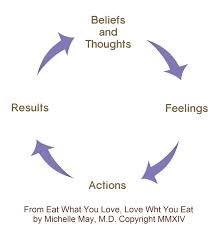
The reason we are starting with Inner Critic is because feelings and emotions are our bodies’ physical reactions to our thoughts and beliefs. It’s a simple thing of thinking nicely of our selves, feeling great and then being able to act on it and produce better results.

And mother-daughter, mother-child connection is the most emphatic connection of all existing in human relationships. Empathy is our ability to feel what others feel. It’s been proven by neuroscience that the feelings experienced by mother are directly transmitted to the child, daughter in particular. So whatever a mother’s Inner Critic says rubs off on her daughter’s mind in no time! Affecting our daughter’s behaviour in a good way is possible only through love and it starts with addressing our own thoughts – negative and positive – whichever mother has her daughter will feel, too and it will show. In the end giving love means having it first.